 Pinoy Gaming Network Where Pinoy Gamers Unite!

Chapter II — Inside the Modern Game Studio
“Players remember the worlds they explored. Developers remember the years it took to build them.”
If the first chapter asked why artificial intelligence has become part of modern game development, the next question is perhaps the most important one: what does AI actually do inside a game studio?
The answer is surprisingly ordinary.
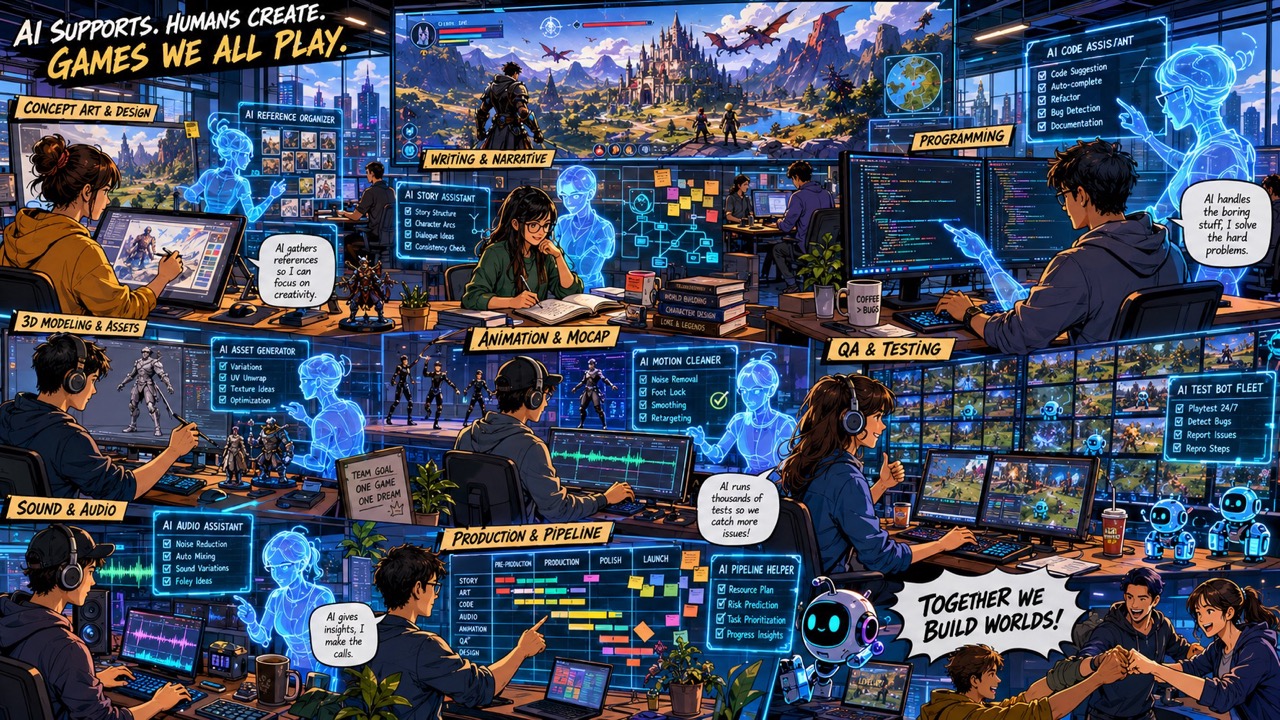
That may sound like an odd way to describe one of the most talked-about technologies of this generation, but the reality inside professional studios is far less dramatic than many public discussions suggest. AI is rarely sitting in a corner “making a game.” It is more likely helping an artist organize reference materials, assisting a programmer with repetitive coding tasks, accelerating animation workflows, or allowing a quality assurance team to identify software defects more efficiently. Most of these activities never appear in a game’s marketing campaign, yet together they influence how quickly—and sometimes how effectively—a game reaches players.
Understanding this distinction requires looking beyond the finished product.
Players experience games as adventures, competitions, or stories. Developers experience them as thousands of interconnected decisions spread across disciplines that must somehow come together without falling apart.
Building a modern video game resembles directing a feature film, constructing a city, writing a novel, composing an orchestra, and engineering a complex software platform—all at the same time. Every department depends on the work of another. A gameplay mechanic affects animation. Animation influences level design. Level design changes enemy behavior. Enemy behavior may require additional voice lines, new sound effects, accessibility adjustments, and extensive testing before the feature can be considered complete.
Artificial intelligence enters this process not because developers lack creativity, but because the production pipeline itself has become extraordinarily demanding.
The industry’s biggest challenge is no longer imagining ambitious ideas.
It is delivering those ideas within the realities of time, budget, and human capacity.
The Blank Canvas Is Still Human
One misconception about AI deserves to be addressed before we go any further.
Some people imagine that modern studios begin development by asking an AI to generate a game concept. In practice, that is not how professional game development works.
Every successful game begins with a vision.
Sometimes that vision is remarkably simple.
“What if players could climb absolutely everything?”
“What if an entire mystery unfolded inside a single apartment building?”
“What if survival depended on understanding an ecosystem instead of defeating enemies?”
Ideas like these do not emerge from predictive algorithms. They come from observation, experience, curiosity, and countless conversations between creative people trying to build something that feels different from everything players have already experienced.
Once that vision exists, however, the practical work begins.
Concept artists sketch environments that may never appear in the final game. Writers produce pages of lore that players might never read. Designers prototype mechanics that are discarded after only a few days of testing. Entire levels are built, evaluated, and abandoned because they simply are not fun.
Failure is not an exception during development.
It is the process.
This is one area where AI has become genuinely valuable—not because it eliminates experimentation, but because it allows experimentation to happen more quickly.
An artist exploring the visual identity of a fictional kingdom might create dozens of rough compositions before settling on a direction. AI-assisted tools can accelerate parts of that exploratory phase by helping generate variations, organize references, or visualize broad concepts. The important point is that these outputs are rarely considered finished artwork. They are stepping stones that help artists refine their own ideas before producing assets that meet the artistic standards of the project.
That distinction often disappears in public conversations about AI.
Brainstorming is not the same as authorship.
Generating possibilities is not the same as making creative decisions.
Professional artists still spend most of their time evaluating, revising, rejecting, and refining ideas. AI may increase the number of possibilities placed before them, but it cannot determine which one best expresses the identity of the game they are trying to create.
In creative work, knowing what to discard is often just as valuable as knowing what to keep.
The Mathematics of Building a World
Earlier, we imagined a castle standing on the horizon.
Let’s return to it.
From the player’s perspective, it is simply another destination waiting to be explored. It occupies a few minutes of curiosity before becoming another memory within a much larger adventure.
For a development team, that same castle may represent months of coordinated work.
Its architecture must complement the surrounding landscape while remaining visually distinctive enough to capture the player’s attention. Interior spaces need to support exploration, combat, storytelling, and navigation without becoming confusing. Environmental artists carefully place vegetation, debris, lighting, and decorative objects so the location feels believable rather than artificially assembled. Audio designers create subtle echoes, distant wind, and ambient sounds that reinforce the atmosphere without overwhelming the player. Quest designers determine why the castle matters, while programmers ensure that every interactive element functions reliably across multiple platforms.
Multiply that process across hundreds of locations, thousands of environmental assets, countless animations, and millions of lines of code, and a broader picture begins to emerge.
Modern game development is, in many respects, a problem of scale.
This explains why procedural technologies have become increasingly important over the past two decades. Contrary to popular belief, procedural generation is not synonymous with generative AI. Developers have long relied on procedural systems to distribute vegetation, generate terrain, simulate ecosystems, or organize large environments according to rules established by designers. Those systems help manage complexity while preserving artistic control.
AI builds upon that philosophy rather than replacing it.
Instead of manually performing every repetitive task, developers increasingly ask intelligent tools to assist with operations that follow recognizable patterns. A designer may establish the ecological rules governing how forests grow across a landscape, while procedural systems handle much of the repetitive placement. The human still defines the intent. The software performs the repetition.
That distinction may sound technical, but it reflects one of the central themes of this editorial.
AI is proving most useful not where creativity begins, but where repetition begins.
Programming Has Always Been More Than Writing Code
Popular culture often portrays programming as an endless stream of code flowing across computer monitors. Anyone who has worked on a large software project knows the reality is considerably less glamorous.
Programming is primarily about solving problems.
Writing code is simply one way of expressing those solutions.
Professional game programmers spend a remarkable amount of time reading documentation, reviewing existing systems, discussing architecture with colleagues, debugging unexpected behavior, and ensuring that hundreds of interconnected components continue working together as new features are introduced. Typing code occupies only part of the job.
This context helps explain why AI coding assistants have attracted so much attention across the software industry.
Contrary to some media narratives, these tools are not replacing experienced engineers. They are reducing the amount of routine work required to reach a solution. Generating boilerplate code, suggesting syntax, identifying common mistakes, or summarizing documentation may seem like modest improvements in isolation. Across projects spanning several years and involving hundreds of developers, however, those small efficiencies accumulate.
The value of these tools is therefore not measured by the number of lines of code they produce.
It is measured by the amount of mental energy developers can redirect toward the problems that still require human judgment.
Experienced engineers often describe programming as a process of asking increasingly better questions.
AI may help answer some of them.
People still decide which questions matter.
When Animation Stops Feeling Mechanical
One of the easiest ways to break immersion in a video game is through unnatural movement.
Players may not consciously analyze animation systems, yet they immediately notice when characters glide across the ground, repeat identical gestures, or transition awkwardly between actions. Believability often depends on countless details that remain invisible precisely because they work so well.
Modern animation pipelines have grown significantly more sophisticated as player expectations have increased. Motion capture, procedural animation, inverse kinematics, physics simulations, and animation blending now work together to create characters that respond naturally to changing environments.
AI is gradually becoming another contributor to that pipeline.
Rather than replacing animators, intelligent tools increasingly assist with tasks such as cleaning motion-capture data, generating transition poses, predicting movement adjustments, or accelerating repetitive animation work. Human animators still determine performance, personality, timing, and emotional expression. AI simply helps remove technical friction that would otherwise consume valuable production time.
The distinction mirrors what we have seen throughout this chapter.
When AI succeeds, it often disappears into the workflow.
Players remember expressive characters.
Animators remember the thousands of technical decisions required to make those performances believable.
The Quiet Partnership
By the time a modern game reaches players, AI may have touched dozens of stages throughout its production. It may have helped organize creative references, supported programmers, accelerated animation workflows, assisted localization teams, or expanded the reach of quality assurance testing. Yet if everything has gone according to plan, players rarely notice any of it.
That invisibility is not a failure.
It is the goal.
No one buys a game because its production pipeline was efficient.
Players invest their time because they expect unforgettable adventures, memorable characters, satisfying mechanics, and stories that stay with them long after the credits roll.
The most successful studios understand this instinctively. They do not adopt AI because it is fashionable, nor because it generates impressive demonstrations during technology conferences. They adopt it selectively when it helps talented people spend less time wrestling with repetitive production work and more time creating experiences that feel unmistakably human.
That balance between efficiency and artistry is beginning to define the next generation of game development.
It also leads naturally to a far more difficult conversation.
As AI becomes increasingly capable, how do developers preserve the authenticity, originality, and trust that players expect from the people behind the games they love?
That question has no simple answer.
But it is one the industry can no longer avoid.