 Pinoy Gaming Network Where Pinoy Gamers Unite!

Chapter IV — Beyond the Algorithm
“Technology changes every generation of games. The reasons we remember them have remained remarkably constant.”
Every era of game development has been defined by a technological breakthrough that promised to transform the medium. Three-dimensional graphics expanded the scale of virtual worlds. Broadband internet made persistent online communities possible. Motion capture brought subtle human performances into interactive storytelling, while increasingly powerful game engines enabled smaller studios to build experiences that once required enormous technical resources. Each advancement reshaped development in meaningful ways, yet none of them fundamentally changed why people became emotionally attached to games.
Players rarely remember a title because it introduced a more efficient production pipeline or adopted the latest rendering technique before its competitors. They remember the first time they stepped into an unfamiliar world and felt compelled to keep exploring. They remember solving a puzzle that seemed impossible only moments before, defeating a boss after dozens of failed attempts, or reaching an ending that lingered in their thoughts long after the credits finished rolling. Those experiences endure because they are emotional rather than technical. Technology makes them possible, but it is not the reason they matter.
Artificial intelligence now joins this long history of transformative tools. Like every innovation before it, it expands what developers are capable of building while simultaneously challenging the industry to reconsider how those capabilities should be used. The significance of AI, therefore, is not that it introduces change—change has always been part of game development—but that it encourages the industry to distinguish more clearly than ever between what can be automated and what should remain an expression of human creativity.
Progress Has Never Been Measured by Automation Alone
One of the recurring assumptions surrounding AI is that technological progress naturally follows a single direction: toward greater automation, faster production, and fewer manual processes. From a manufacturing perspective, that reasoning appears sensible. In creative industries, however, progress has rarely been measured solely by efficiency.
If efficiency alone determined artistic success, the largest development teams would consistently produce the most memorable games. History suggests otherwise. Some of the industry’s most influential titles emerged not because they possessed the biggest budgets or the most advanced technology of their time, but because they introduced fresh ideas, distinctive artistic identities, or new ways of engaging players. Innovation in game development has always depended as much on creative risk as on technical achievement.
Artificial intelligence does not change that relationship. It may reduce the time required to complete certain production tasks, allowing studios to iterate more quickly or allocate resources more effectively. Yet no algorithm can determine whether a mechanic is genuinely enjoyable, whether a story resonates emotionally, or whether a world invites curiosity rather than obligation. Those judgments require taste, empathy, cultural awareness, and an understanding of human experience that extends beyond pattern recognition.
For that reason, discussions about AI should not focus exclusively on what developers can automate next. They should also consider what automation makes possible. If repetitive tasks consume less time, creative teams gain additional opportunities to refine gameplay, strengthen narrative cohesion, improve accessibility, or simply polish details that might otherwise remain unfinished. In that sense, the true value of AI may not be measured by how much work it performs, but by the creative freedom it gives back to the people directing the project.
The Games We Will Remember
Earlier in this editorial, we returned several times to the image of a castle standing on the horizon. It served first as a symbol of production complexity and later as an illustration of how meaning emerges through design rather than technical execution. Before leaving it behind, it is worth considering one final question.
Imagine that castle appearing in two different games.
In the first, every stone, banner, corridor, and tower has been assembled through an exceptionally efficient production pipeline supported by advanced AI systems. Technically, it is flawless. Lighting is realistic, textures are detailed, and performance remains stable across every supported platform.
In the second, the castle may have benefited from many of the same technologies, yet what players remember is something else entirely. They remember climbing its highest tower after spending fifty hours unraveling the history of the kingdom. They remember the conversation that took place within its walls, the difficult choice they were forced to make, and the consequences that followed. Years later, they may have forgotten how impressive the rendering technology looked, but they still remember how that moment made them feel.
The difference between those two experiences cannot be explained by technology alone.
It lies in authorship.
One demonstrates technical competence.
The other demonstrates creative intention.
As artificial intelligence becomes increasingly integrated into development pipelines, preserving that distinction may become one of the industry’s most important responsibilities.
A Responsibility Shared by the Entire Industry
It is tempting to assume that decisions about AI belong exclusively to technology companies or large game studios. In reality, the future of AI in gaming will be shaped by a far broader community.
Developers determine how new tools fit within creative workflows. Publishers establish production priorities and allocate resources. Engine developers design the platforms upon which future games will be built. Universities and training institutions prepare the next generation of programmers, artists, designers, and technical specialists. Legislators and courts continue defining the legal frameworks surrounding copyright, licensing, and digital ownership. Finally, players influence the direction of the industry every time they decide which games deserve their attention and support.
This shared responsibility is one reason simplistic narratives about AI rarely withstand closer examination. The future will not be determined by a single technological breakthrough or by one company’s strategic decisions. It will emerge through thousands of individual choices made across an interconnected industry, many of them invisible to players but collectively influential in shaping how games are conceived, developed, and experienced.
For that reason, thoughtful discussion remains more valuable than certainty. The questions surrounding AI are too complex to be resolved through optimism alone or skepticism alone. They require ongoing dialogue between people who care about technology and people who care about creativity, because the future of game development ultimately depends on both.
After the Credits
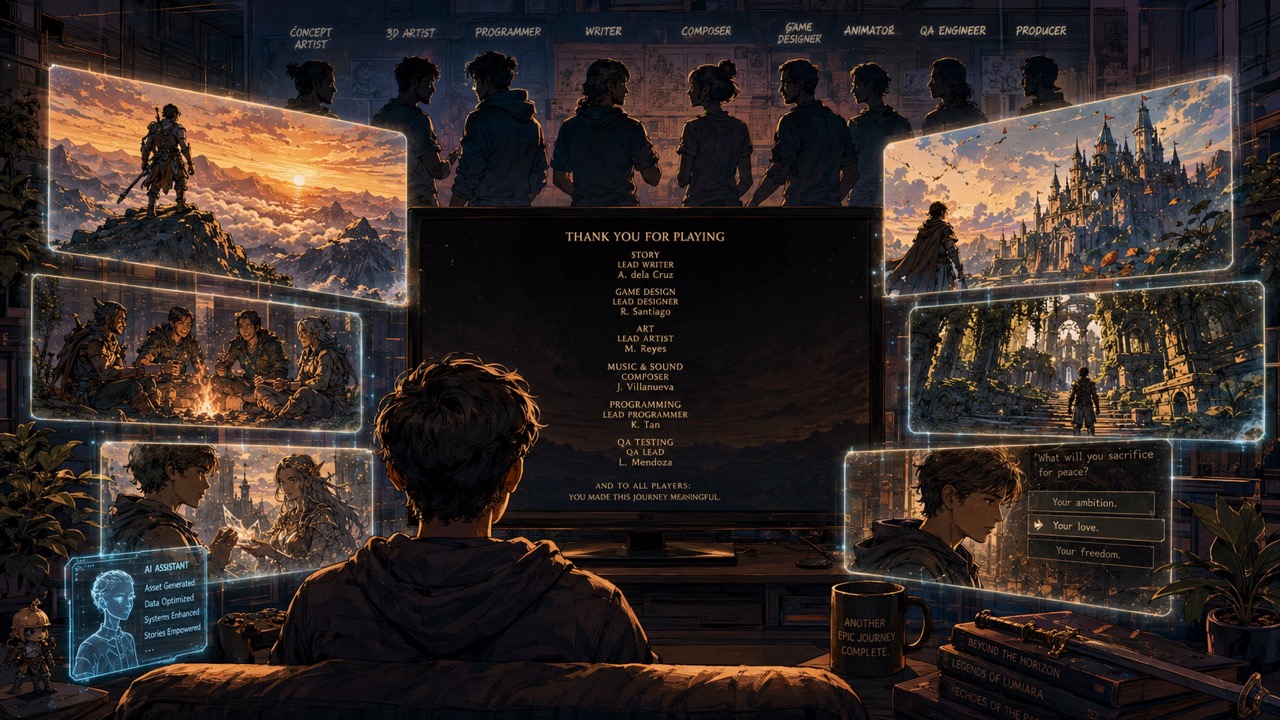
Every memorable game reaches a moment when the action ends, the music softens, and the credits begin to roll. It is often during those final minutes—not during the climactic battle—that players quietly reflect on everything they have experienced. The mechanics fade into the background, leaving only the emotions, ideas, and memories that made the journey worthwhile.
Artificial intelligence may eventually become so deeply integrated into game development that players stop noticing it altogether. If that happens, it will not diminish the importance of the technology. On the contrary, it will suggest that AI has achieved what many foundational technologies achieve at their best: becoming an invisible part of the creative process rather than the center of attention.
Yet even if that future arrives, one truth is unlikely to change.
Games are remembered because they reveal something about the people who create them and the people who play them. They reflect curiosity, imagination, ambition, humor, empathy, and the uniquely human desire to tell stories through interactive worlds. No production pipeline, regardless of how sophisticated, can generate those qualities on its own. Technology may expand the range of what developers can accomplish, but it does not determine why they create in the first place.
Perhaps that is the most useful way to understand AI’s role in gaming.
It is not the author of the industry’s next chapter.
It is another instrument through which talented people may choose to write it.
As developers continue exploring the possibilities of artificial intelligence, the conversation should never lose sight of what has sustained gaming through every previous technological revolution. New tools will continue to emerge. Hardware will become more powerful. Production techniques will evolve, and today’s innovations will eventually become tomorrow’s standard practice. Through all of those changes, however, the measure of a great game will remain remarkably familiar. Players will still ask whether the world felt believable, whether the characters mattered, whether the mechanics respected their time, and whether the experience left them feeling something that could not be replicated elsewhere.
Artificial intelligence will undoubtedly influence the answers to those questions. It may help developers build larger worlds, solve technical problems more efficiently, and explore ideas that once seemed impractical. But the answers themselves will continue to come from people—from the imagination that conceives a world, the craftsmanship that gives it form, and the courage to create something worth remembering.
In the end, that may be the quiet lesson hidden beneath all the excitement surrounding AI.
The future of game development has never depended on technology alone.
It has always depended on what people choose to create with it.