 Pinoy Gaming Network Where Pinoy Gamers Unite!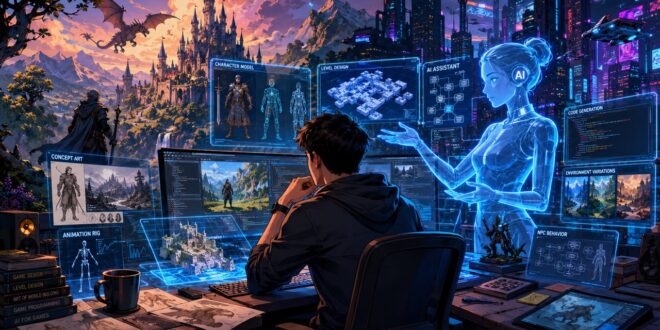

“Every technological breakthrough changes how games are made. Very few change why we play them.”
There is a quiet misconception surrounding modern video games, one that has grown louder with every new headline about artificial intelligence. Spend a few minutes browsing social media or watching technology showcases, and it becomes easy to believe that AI has suddenly appeared to reinvent the gaming industry—that somewhere inside today’s studios, algorithms are replacing artists, programmers, writers, and designers while games begin creating themselves.
It is an appealing narrative. It is also an incomplete one.
The truth is far more interesting than the headlines suggest.
Artificial intelligence did not suddenly arrive in game development when generative AI became the center of public attention. Long before conversational chatbots, image generators, and coding assistants became household names, game developers had already been relying on various forms of artificial intelligence to make virtual worlds believable. In many ways, AI has been quietly growing alongside the industry itself, evolving from simple rule-based systems into increasingly sophisticated tools that support nearly every stage of development. The recent wave of AI innovation did not begin the story—it merely brought decades of gradual progress into public view.
Understanding that history matters because it changes the question we should be asking.
Instead of wondering whether AI will replace game developers, perhaps we should be asking why game development has become so complex that studios are increasingly turning to AI in the first place.
The answer has less to do with artificial intelligence than it does with the extraordinary ambition of modern video games.
The Growing Cost of Wonder
Consider what players expect from a major game release today.
An open-world adventure is no longer judged simply by the size of its map. Players expect cities that feel inhabited, wildlife that behaves naturally, weather systems that influence exploration, enemies that react intelligently, companions with believable personalities, cinematic storytelling, orchestral soundtracks, accessibility features, seamless online services, multilingual localization, and years of post-launch support. Even genres once defined by relatively simple mechanics—such as racing games, sports simulations, or life simulators—are now expected to deliver levels of realism and systemic depth that would have seemed unimaginable two decades ago.
These expectations did not emerge overnight. They are the product of an industry that has consistently pushed technological boundaries while simultaneously raising players’ standards. Every generation of hardware has allowed developers to create larger, denser, and more detailed experiences. With each leap forward, however, the invisible work required to build those experiences has grown even faster.
That invisible work is rarely discussed outside development circles, yet it represents one of the defining challenges of modern game production.
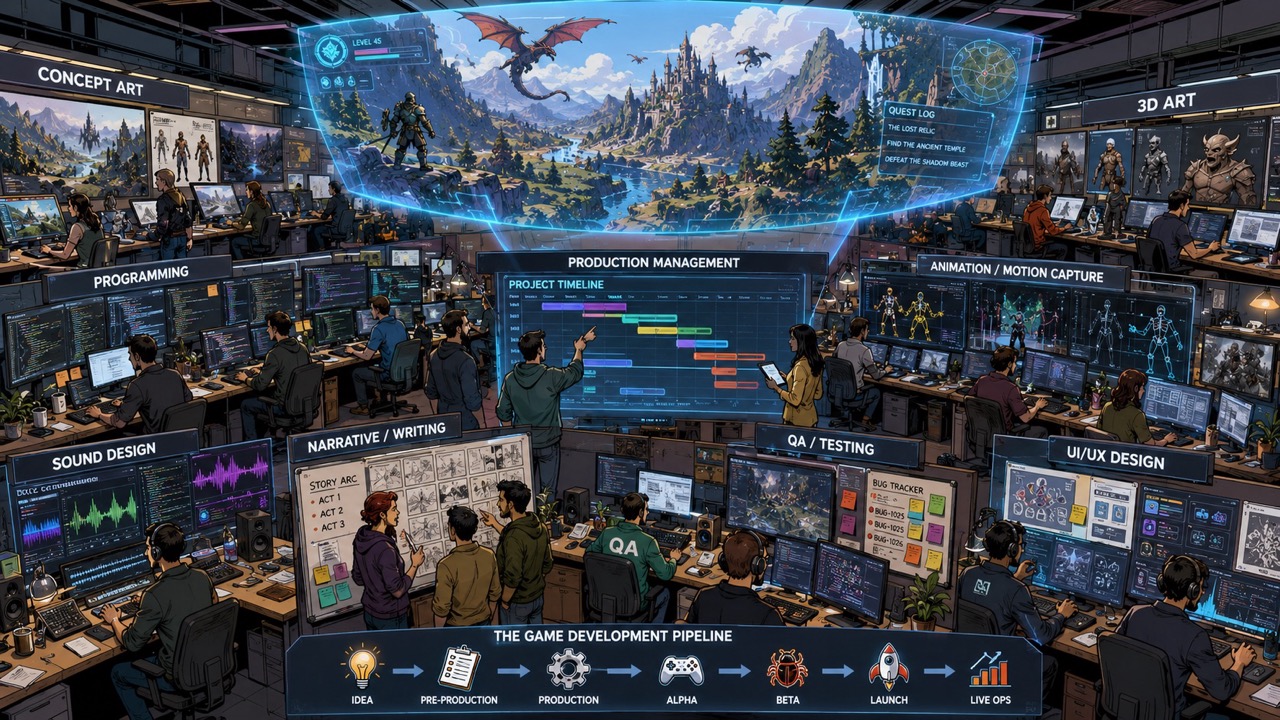
A towering castle visible on the horizon is not simply a piece of architecture. Artists must design it, model it, texture it, light it, optimize it for different hardware configurations, and ensure it integrates naturally with surrounding environments. Designers must determine its purpose within the game world. Writers may create its history. Audio teams develop ambient sounds that give it atmosphere, while programmers ensure that every system—from physics to lighting—functions correctly. Before players ever step through its gates, testers have already explored countless ways to break it.
Now imagine repeating that process thousands of times across an entire game world.
It quickly becomes apparent that modern game development is not merely a creative endeavor. It is one of the most complex collaborative engineering efforts in the entertainment industry.
That complexity explains why AI has become such an important topic—not because developers have run out of ideas, but because they are running out of time.
A History Written Between the Lines
One of the most fascinating aspects of AI in gaming is that many players have been interacting with it for most of their lives without ever noticing.
Think back to the earliest games you played. Whether it was an arcade shooter, a real-time strategy game, or an action platformer, computer-controlled opponents rarely stood still. They pursued objectives, reacted to player actions, defended territory, or searched for efficient paths through virtual environments. Those behaviors may seem simple by today’s standards, yet they represented the foundation of game AI.
As technology advanced, those foundations expanded rather than disappeared.
Strategy games introduced increasingly sophisticated pathfinding systems capable of coordinating hundreds of units across dynamic battlefields. Stealth games taught guards to investigate unusual sounds, communicate alerts, and search environments instead of merely following fixed patrol routes. Racing games adjusted computer-controlled opponents to create more competitive experiences, while role-playing games developed companions capable of assisting players in increasingly believable ways.
None of these systems resembled today’s generative AI, nor were they intended to.
Their purpose was different.
They existed to solve specific design problems while preserving something every game depends upon: the illusion of life.
Players rarely stop to admire an elegant pathfinding algorithm or an efficient decision tree. They simply remember that enemies behaved intelligently enough to make victory satisfying. Like film editing or orchestral sound design, successful game AI often becomes invisible precisely because it performs its role so well.
This is an important perspective to remember as conversations about AI continue evolving.
The gaming industry did not suddenly embrace artificial intelligence.
It has been refining it for decades.
Why 2026 Feels Different
If AI has always been part of gaming, why does it suddenly dominate industry discussions?
Because the role of AI has fundamentally changed.
For most of gaming history, artificial intelligence existed almost exclusively inside the game itself. It determined how enemies behaved, how traffic navigated city streets, how wildlife responded to danger, or how opponents adapted to player decisions. The player experienced AI indirectly through gameplay.
Today’s AI increasingly works behind the scenes, assisting the people who create those experiences.
This shift may ultimately prove more significant than any improvement to enemy behavior.
Inside modern studios, AI is beginning to assist artists during early concept exploration, programmers with routine coding tasks, animators with labor-intensive workflows, quality assurance teams with repetitive testing, and localization specialists responsible for preparing games for global audiences. These applications differ dramatically in both capability and maturity, yet they all share a common objective: reducing repetitive work so creative professionals can devote more time to solving creative problems.
That distinction deserves emphasis because it is often lost amid public debate.
The most valuable contribution AI currently offers many development teams is not autonomous creativity.
It is productive collaboration.
The difference may appear subtle, but it changes the entire conversation.
A paintbrush never painted a masterpiece on its own.
A game engine never designed an unforgettable world.
Likewise, AI does not decide which stories deserve to be told or which mechanics will inspire millions of players. Those decisions continue to emerge from human experience, intuition, empathy, and imagination.
Technology changes the tools.
People define the vision.
As the gaming industry enters another period of technological transformation, perhaps that is the lesson worth remembering before we begin asking whether AI will shape the future of games.
History suggests it already is.
The more interesting question is how developers will choose to use it.