 Pinoy Gaming Network Where Pinoy Gamers Unite!

Chapter III — The Human Craft
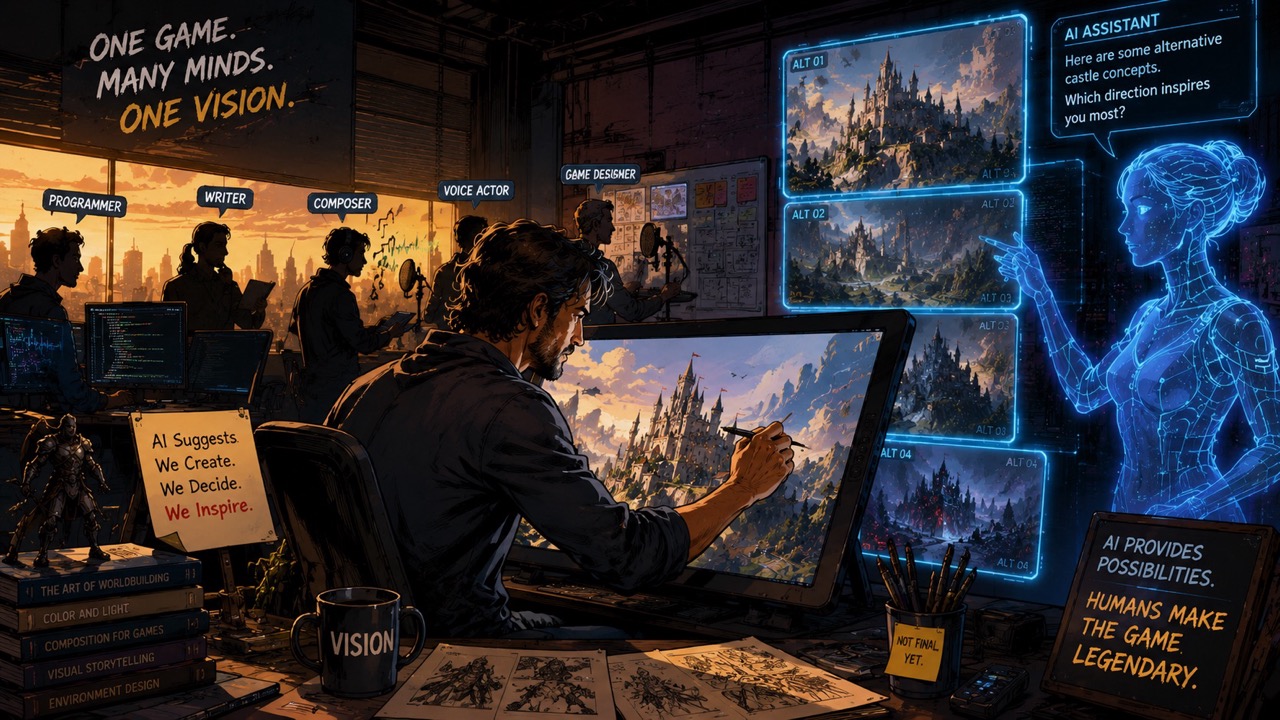
“Every generation inherits better tools. What defines that generation is not the sophistication of those tools, but the wisdom with which they are used.”
If the first two chapters established that artificial intelligence is becoming an increasingly important part of modern game development, they also lead us toward a more difficult conversation. Technical capability is only one side of technological progress. The other concerns judgment—how an industry decides where a tool belongs, where it does not, and what should remain fundamentally human regardless of how advanced the technology becomes. These questions are more difficult because they cannot be answered through engineering alone. They require developers, publishers, artists, and players to think carefully about the kind of creative industry they want game development to become over the next decade.
History suggests that this is not an entirely new dilemma. Every major technological shift has forced creative professions to reconsider the relationship between craftsmanship and efficiency. Digital photography did not eliminate photographers, nor did motion capture replace animators. Modern game engines made development faster, but they did not diminish the importance of programming expertise or thoughtful game design. In each case, the technology altered workflows rather than the underlying purpose of the craft. The most successful professionals were rarely those who resisted change entirely or embraced it uncritically. Instead, they learned how to integrate new tools without allowing those tools to dictate the creative process. Artificial intelligence now presents the gaming industry with a remarkably similar challenge, although its influence extends across far more disciplines than any previous technological innovation.
The Difference Between Producing Content and Creating Meaning
Much of the public conversation surrounding AI assumes that producing more content naturally leads to better games. It is an understandable assumption because modern AI systems can generate images, suggest dialogue, assist with programming, and accelerate numerous production tasks. Yet anyone who has participated in creative work knows that quantity and quality have never been synonymous. The most difficult part of game development has never been generating possibilities; it has always been deciding which possibilities deserve to become part of the final experience.
The castle we imagined earlier provides a useful example. From a technical perspective, software can eventually generate countless architectural variations, complete with towers, walls, courtyards, and intricate decorative details. None of those elements, however, explain why the castle exists within the world or why players should care about it. Was it abandoned after a civil war? Does it protect an ancient secret? Is it a symbol of a kingdom’s decline or the setting for a pivotal moment in the story? These questions transform a collection of digital assets into a place that carries emotional weight. They cannot be answered through geometry, texture resolution, or procedural rules alone because they belong to narrative intent rather than technical execution.
This distinction helps explain why experienced developers often speak about design in terms of purpose rather than production. A memorable game is not simply a collection of impressive assets assembled efficiently. It is a carefully orchestrated experience in which mechanics, environments, characters, music, and storytelling support one another toward a shared creative vision. AI may contribute to many stages of that process, but it does not determine the vision itself. It can accelerate production, yet it cannot decide why a particular story deserves to be told or why one emotional moment should matter more than another. Those decisions continue to emerge from human judgment, and they remain the foundation upon which every memorable game is built.
Why the Debate Among Artists Is More Nuanced Than It Appears
Public discussions often portray the relationship between artists and AI as a straightforward conflict between those who support the technology and those who reject it. In reality, the conversation is considerably more nuanced. Many professional artists already rely on intelligent software features that automate repetitive tasks such as object selection, masking, image restoration, or content-aware editing. These capabilities have gradually become ordinary parts of digital production because they reduce manual labor without replacing the creative decisions that define an artist’s work.
The controversy surrounding generative AI stems from different concerns altogether. Questions surrounding training data, copyright, licensing, attribution, and informed consent remain the subject of ongoing legal and ethical debate across multiple jurisdictions. For many artists, the issue is not whether AI should exist, but whether creative work used to develop these systems has been obtained and applied in ways that respect the rights of its original creators. Those concerns deserve careful consideration because trust has always been central to creative industries. When technology evolves more quickly than the legal and ethical frameworks governing its use, uncertainty is inevitable.
Reducing this discussion to a simple choice between embracing or rejecting AI does little to advance the conversation. Most creative professionals are not arguing against innovation itself. They are asking whether innovation can coexist with fairness, transparency, and professional respect. Those are fundamentally different questions, and they deserve answers that are equally thoughtful rather than polarized.
Performance Is More Than Data
The same complexity appears in discussions surrounding voice acting and performance capture. Advances in voice synthesis have demonstrated that software can reproduce certain vocal characteristics with remarkable accuracy under specific conditions. For developers, these technologies may eventually provide valuable assistance in areas such as temporary dialogue, accessibility, or localization workflows. For performers, however, they introduce questions that extend well beyond technical capability.
A memorable performance is not simply the result of producing spoken words. It reflects interpretation, emotional timing, lived experience, and countless subtle decisions that audiences rarely notice consciously but instinctively recognize. Players remember hesitation before a difficult confession, the quiet determination in a hero’s final speech, or the restrained emotion that makes a tragic scene believable. Those moments arise because actors make creative choices about how a character should feel rather than merely how a line should sound.
This is why discussions about AI-generated voices increasingly focus on consent and ownership instead of technology alone. If a performer’s voice becomes part of a digital system capable of generating new dialogue indefinitely, questions about permission, compensation, and creative control become unavoidable. The technology itself is neither ethical nor unethical. Its impact depends entirely on the standards the industry establishes around its use, reinforcing a broader theme that has emerged throughout this editorial: tools acquire meaning only through the choices people make with them.
A Different Opportunity for the Philippines
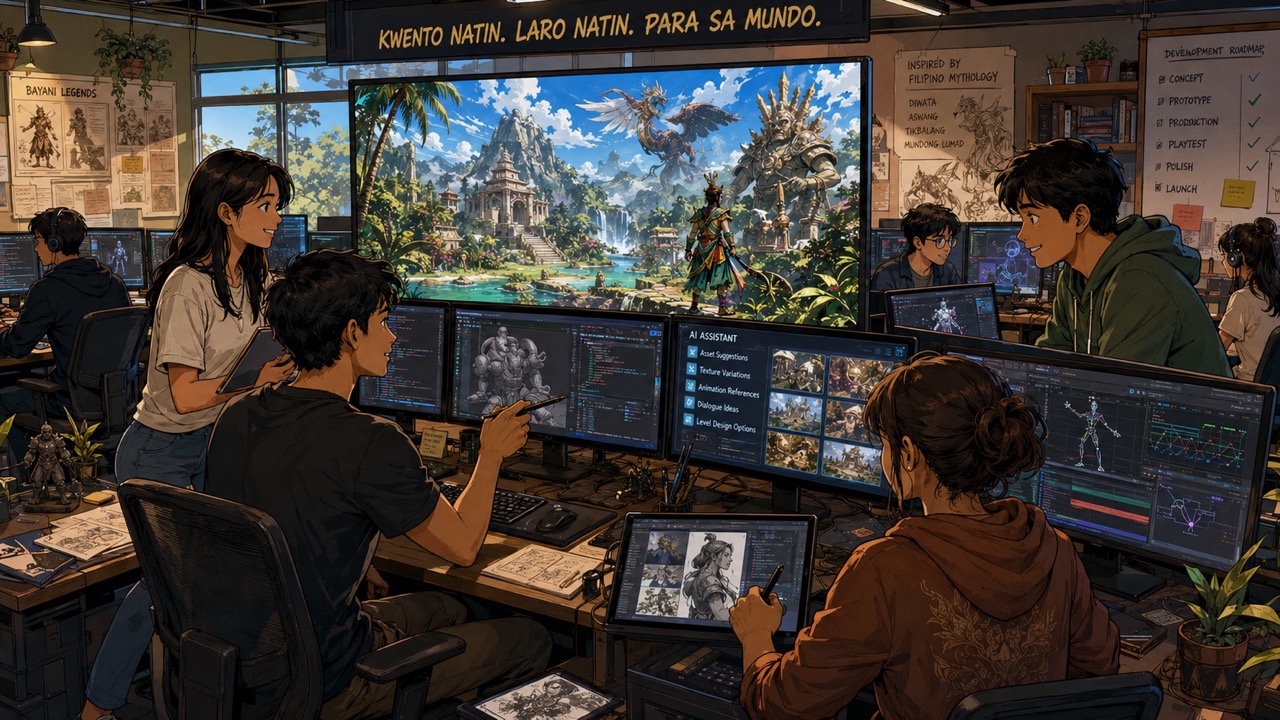
For the Philippine game development community, the rise of AI presents a conversation that differs slightly from those taking place in larger development hubs. Local studios have historically operated under constraints that are less about creativity than about resources. Many Filipino developers possess internationally recognized skills in programming, art, animation, and quality assurance, yet independent studios often work with limited funding, smaller teams, and tighter production schedules than their counterparts abroad.
Viewed from that perspective, AI becomes less a replacement for creative professionals and more a potential force multiplier. Intelligent tools may help smaller teams organize production, accelerate prototyping, improve documentation, expand testing capacity, or shorten repetitive workflows that previously consumed valuable development time. None of these advantages eliminates the structural challenges facing independent studios, nor do they guarantee commercial success. What they may do, however, is allow talented developers to spend a greater proportion of their limited resources on the aspects of game development that players ultimately value most: thoughtful design, polished gameplay, and original ideas.
That possibility carries particular significance for the Philippines because the country’s greatest competitive advantage has never been scale. It has always been talent. If AI enables smaller teams to compete more effectively without compromising their creative identity, it could become one of several tools that help Filipino studios bring more original stories to international audiences. Achieving that outcome will depend not on technology alone, but on sustained investment in education, creative leadership, and a willingness to build intellectual property that reflects local perspectives rather than merely following global trends.
Preparing the Next Generation of Developers
Perhaps no group watches these developments more closely than students preparing to enter the gaming industry. Questions about whether AI will replace programmers, artists, or designers have become increasingly common in classrooms and online communities. Although understandable, these questions often begin from a mistaken assumption—that technical proficiency alone has ever been sufficient for a successful career in game development.
The industry’s history suggests otherwise. Strong programmers have always been distinguished not simply by their ability to write code, but by their capacity to solve complex problems. Exceptional artists are valued not because they can produce images quickly, but because they understand composition, color, anatomy, visual storytelling, and artistic intent. Designers succeed because they understand players, balancing systems, pacing, and human psychology. These foundational skills remain just as important in an era of AI as they were before it.
In fact, the widespread adoption of intelligent tools may increase the value of expertise rather than diminish it. When software can rapidly generate multiple solutions, someone must still evaluate which solution is appropriate, identify subtle flaws, refine rough ideas, and recognize opportunities that no algorithm has considered. Students entering the profession should certainly learn how AI fits into modern workflows, but they should never confuse mastery of a tool with mastery of the craft itself. Tools evolve continuously. Foundational knowledge endures.
The Question Technology Cannot Answer
Throughout this chapter, we have examined the perspectives of artists, actors, programmers, students, and independent studios. Their concerns differ in important ways, yet they ultimately return to the same underlying issue. The central challenge facing the industry is no longer whether artificial intelligence will become more capable; that trajectory is already evident. The more important question is whether the people adopting these technologies can remain deliberate in how they use them, ensuring that efficiency never becomes a substitute for creativity or thoughtful design.
Technology has never possessed values of its own. Every tool reflects the priorities of the people who build it and the people who decide how it will be applied. Artificial intelligence is no exception. It can be used to reduce repetitive work and create more time for experimentation, collaboration, and artistic refinement, or it can be treated primarily as a means of producing greater quantities of content in less time. Those approaches are not equivalent, and the choices developers make today will influence not only production practices but also the creative culture of the industry for years to come.
For that reason, the discussion surrounding AI cannot be reduced to software capabilities or computational performance alone. It is ultimately a conversation about stewardship—about how an industry chooses to balance innovation with responsibility, productivity with craftsmanship, and technological progress with creative integrity. Artificial intelligence will undoubtedly continue to reshape game development, but it will never determine the purpose of that work. As every chapter of this editorial has argued, the purpose has always come from people: from the developers who imagine new worlds, the artists who give them identity, and the players who ultimately decide whether those worlds are worth remembering.