


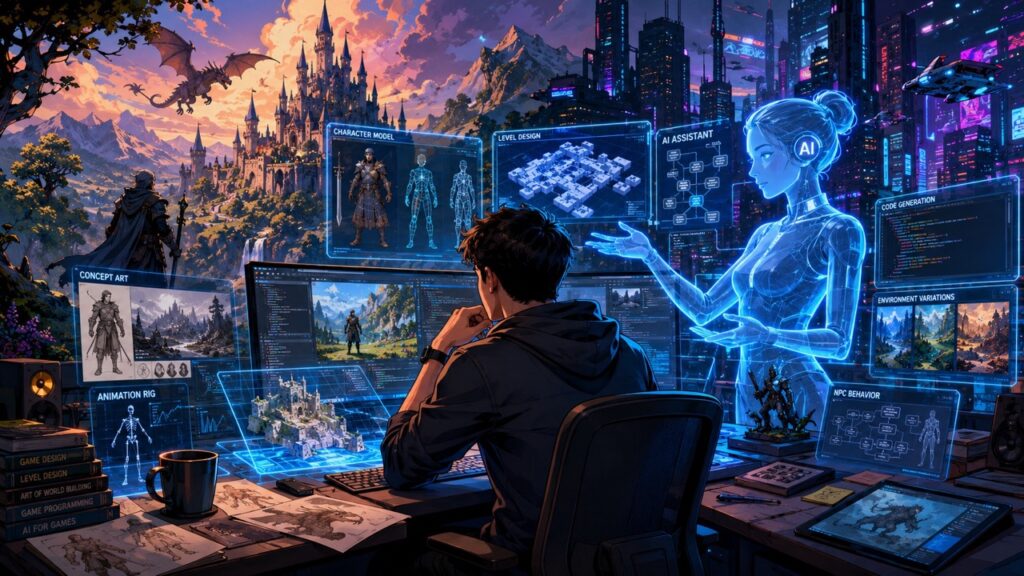
“Every technological breakthrough changes how games are made. Very few change why we play them.”
There is a quiet misconception surrounding modern video games, one that has grown louder with every new headline about artificial intelligence. Spend a few minutes browsing social media or watching technology showcases, and it becomes easy to believe that AI has suddenly appeared to reinvent the gaming industry—that somewhere inside today’s studios, algorithms are replacing artists, programmers, writers, and designers while games begin creating themselves.
It is an appealing narrative. It is also an incomplete one.
The truth is far more interesting than the headlines suggest.
Artificial intelligence did not suddenly arrive in game development when generative AI became the center of public attention. Long before conversational chatbots, image generators, and coding assistants became household names, game developers had already been relying on various forms of artificial intelligence to make virtual worlds believable. In many ways, AI has been quietly growing alongside the industry itself, evolving from simple rule-based systems into increasingly sophisticated tools that support nearly every stage of development. The recent wave of AI innovation did not begin the story—it merely brought decades of gradual progress into public view.
Understanding that history matters because it changes the question we should be asking.
Instead of wondering whether AI will replace game developers, perhaps we should be asking why game development has become so complex that studios are increasingly turning to AI in the first place.
The answer has less to do with artificial intelligence than it does with the extraordinary ambition of modern video games.
The Growing Cost of Wonder
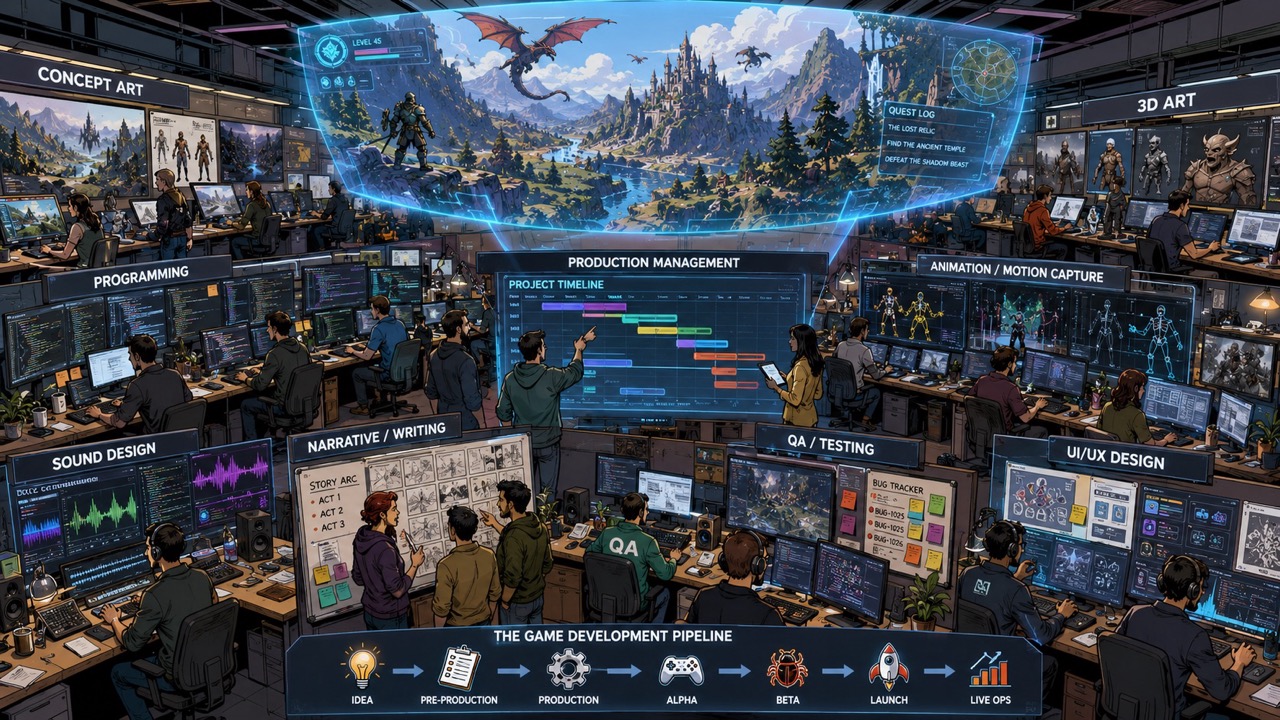
Consider what players expect from a major game release today.
An open-world adventure is no longer judged simply by the size of its map. Players expect cities that feel inhabited, wildlife that behaves naturally, weather systems that influence exploration, enemies that react intelligently, companions with believable personalities, cinematic storytelling, orchestral soundtracks, accessibility features, seamless online services, multilingual localization, and years of post-launch support. Even genres once defined by relatively simple mechanics—such as racing games, sports simulations, or life simulators—are now expected to deliver levels of realism and systemic depth that would have seemed unimaginable two decades ago.
These expectations did not emerge overnight. They are the product of an industry that has consistently pushed technological boundaries while simultaneously raising players’ standards. Every generation of hardware has allowed developers to create larger, denser, and more detailed experiences. With each leap forward, however, the invisible work required to build those experiences has grown even faster.
That invisible work is rarely discussed outside development circles, yet it represents one of the defining challenges of modern game production.
A towering castle visible on the horizon is not simply a piece of architecture. Artists must design it, model it, texture it, light it, optimize it for different hardware configurations, and ensure it integrates naturally with surrounding environments. Designers must determine its purpose within the game world. Writers may create its history. Audio teams develop ambient sounds that give it atmosphere, while programmers ensure that every system—from physics to lighting—functions correctly. Before players ever step through its gates, testers have already explored countless ways to break it.
Now imagine repeating that process thousands of times across an entire game world.
It quickly becomes apparent that modern game development is not merely a creative endeavor. It is one of the most complex collaborative engineering efforts in the entertainment industry.
That complexity explains why AI has become such an important topic—not because developers have run out of ideas, but because they are running out of time.
A History Written Between the Lines
One of the most fascinating aspects of AI in gaming is that many players have been interacting with it for most of their lives without ever noticing.
Think back to the earliest games you played. Whether it was an arcade shooter, a real-time strategy game, or an action platformer, computer-controlled opponents rarely stood still. They pursued objectives, reacted to player actions, defended territory, or searched for efficient paths through virtual environments. Those behaviors may seem simple by today’s standards, yet they represented the foundation of game AI.
As technology advanced, those foundations expanded rather than disappeared.
Strategy games introduced increasingly sophisticated pathfinding systems capable of coordinating hundreds of units across dynamic battlefields. Stealth games taught guards to investigate unusual sounds, communicate alerts, and search environments instead of merely following fixed patrol routes. Racing games adjusted computer-controlled opponents to create more competitive experiences, while role-playing games developed companions capable of assisting players in increasingly believable ways.
None of these systems resembled today’s generative AI, nor were they intended to.
Their purpose was different.
They existed to solve specific design problems while preserving something every game depends upon: the illusion of life.
Players rarely stop to admire an elegant pathfinding algorithm or an efficient decision tree. They simply remember that enemies behaved intelligently enough to make victory satisfying. Like film editing or orchestral sound design, successful game AI often becomes invisible precisely because it performs its role so well.
This is an important perspective to remember as conversations about AI continue evolving.
The gaming industry did not suddenly embrace artificial intelligence.
It has been refining it for decades.
Why 2026 Feels Different
If AI has always been part of gaming, why does it suddenly dominate industry discussions?
Because the role of AI has fundamentally changed.
For most of gaming history, artificial intelligence existed almost exclusively inside the game itself. It determined how enemies behaved, how traffic navigated city streets, how wildlife responded to danger, or how opponents adapted to player decisions. The player experienced AI indirectly through gameplay.
Today’s AI increasingly works behind the scenes, assisting the people who create those experiences.
This shift may ultimately prove more significant than any improvement to enemy behavior.
Inside modern studios, AI is beginning to assist artists during early concept exploration, programmers with routine coding tasks, animators with labor-intensive workflows, quality assurance teams with repetitive testing, and localization specialists responsible for preparing games for global audiences. These applications differ dramatically in both capability and maturity, yet they all share a common objective: reducing repetitive work so creative professionals can devote more time to solving creative problems.
That distinction deserves emphasis because it is often lost amid public debate.
The most valuable contribution AI currently offers many development teams is not autonomous creativity.
It is productive collaboration.
The difference may appear subtle, but it changes the entire conversation.
A paintbrush never painted a masterpiece on its own.
A game engine never designed an unforgettable world.
Likewise, AI does not decide which stories deserve to be told or which mechanics will inspire millions of players. Those decisions continue to emerge from human experience, intuition, empathy, and imagination.
Technology changes the tools.
People define the vision.
As the gaming industry enters another period of technological transformation, perhaps that is the lesson worth remembering before we begin asking whether AI will shape the future of games.
History suggests it already is.
The more interesting question is how developers will choose to use it.
Chapter II — Inside the Modern Game Studio
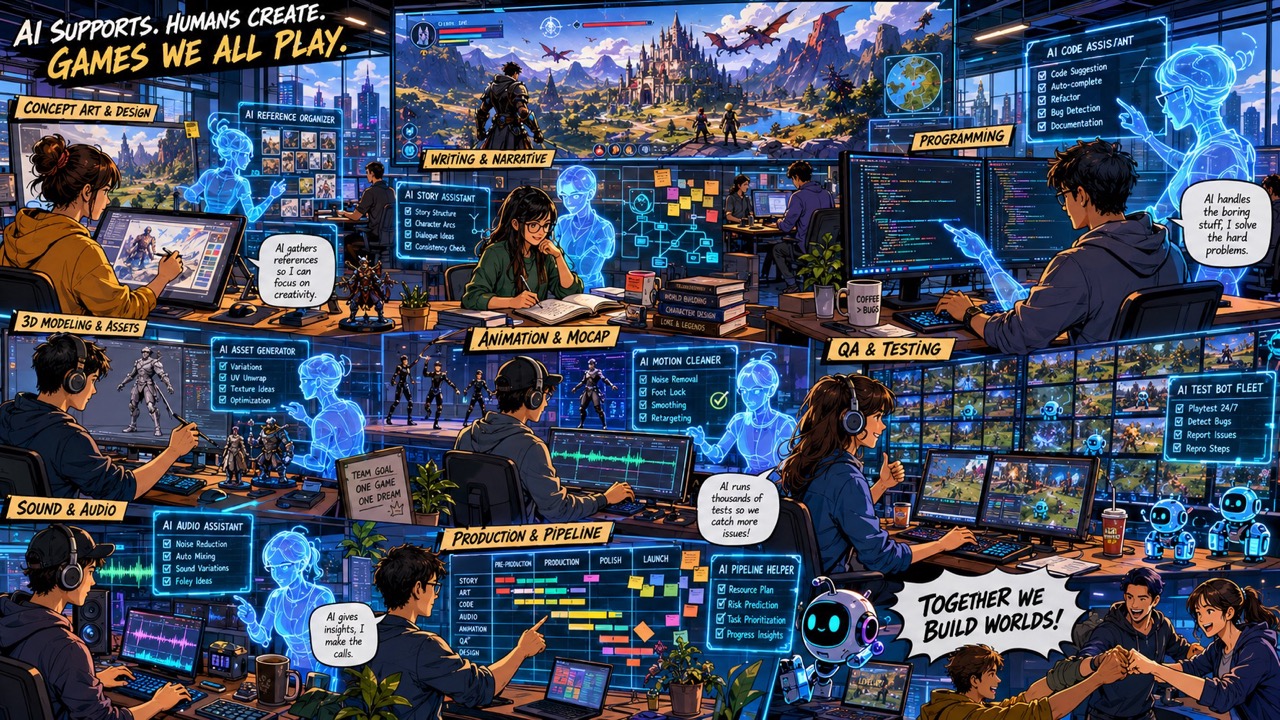
“Players remember the worlds they explored. Developers remember the years it took to build them.”
If the first chapter asked why artificial intelligence has become part of modern game development, the next question is perhaps the most important one: what does AI actually do inside a game studio?
The answer is surprisingly ordinary.
That may sound like an odd way to describe one of the most talked-about technologies of this generation, but the reality inside professional studios is far less dramatic than many public discussions suggest. AI is rarely sitting in a corner “making a game.” It is more likely helping an artist organize reference materials, assisting a programmer with repetitive coding tasks, accelerating animation workflows, or allowing a quality assurance team to identify software defects more efficiently. Most of these activities never appear in a game’s marketing campaign, yet together they influence how quickly—and sometimes how effectively—a game reaches players.
Understanding this distinction requires looking beyond the finished product.
Players experience games as adventures, competitions, or stories. Developers experience them as thousands of interconnected decisions spread across disciplines that must somehow come together without falling apart.
Building a modern video game resembles directing a feature film, constructing a city, writing a novel, composing an orchestra, and engineering a complex software platform—all at the same time. Every department depends on the work of another. A gameplay mechanic affects animation. Animation influences level design. Level design changes enemy behavior. Enemy behavior may require additional voice lines, new sound effects, accessibility adjustments, and extensive testing before the feature can be considered complete.
Artificial intelligence enters this process not because developers lack creativity, but because the production pipeline itself has become extraordinarily demanding.
The industry’s biggest challenge is no longer imagining ambitious ideas.
It is delivering those ideas within the realities of time, budget, and human capacity.
The Blank Canvas Is Still Human
One misconception about AI deserves to be addressed before we go any further.
Some people imagine that modern studios begin development by asking an AI to generate a game concept. In practice, that is not how professional game development works.
Every successful game begins with a vision.
Sometimes that vision is remarkably simple.
“What if players could climb absolutely everything?”
“What if an entire mystery unfolded inside a single apartment building?”
“What if survival depended on understanding an ecosystem instead of defeating enemies?”
Ideas like these do not emerge from predictive algorithms. They come from observation, experience, curiosity, and countless conversations between creative people trying to build something that feels different from everything players have already experienced.
Once that vision exists, however, the practical work begins.
Concept artists sketch environments that may never appear in the final game. Writers produce pages of lore that players might never read. Designers prototype mechanics that are discarded after only a few days of testing. Entire levels are built, evaluated, and abandoned because they simply are not fun.
Failure is not an exception during development.
It is the process.
This is one area where AI has become genuinely valuable—not because it eliminates experimentation, but because it allows experimentation to happen more quickly.
An artist exploring the visual identity of a fictional kingdom might create dozens of rough compositions before settling on a direction. AI-assisted tools can accelerate parts of that exploratory phase by helping generate variations, organize references, or visualize broad concepts. The important point is that these outputs are rarely considered finished artwork. They are stepping stones that help artists refine their own ideas before producing assets that meet the artistic standards of the project.
That distinction often disappears in public conversations about AI.
Brainstorming is not the same as authorship.
Generating possibilities is not the same as making creative decisions.
Professional artists still spend most of their time evaluating, revising, rejecting, and refining ideas. AI may increase the number of possibilities placed before them, but it cannot determine which one best expresses the identity of the game they are trying to create.
In creative work, knowing what to discard is often just as valuable as knowing what to keep.
The Mathematics of Building a World
Earlier, we imagined a castle standing on the horizon.
Let’s return to it.
From the player’s perspective, it is simply another destination waiting to be explored. It occupies a few minutes of curiosity before becoming another memory within a much larger adventure.
For a development team, that same castle may represent months of coordinated work.
Its architecture must complement the surrounding landscape while remaining visually distinctive enough to capture the player’s attention. Interior spaces need to support exploration, combat, storytelling, and navigation without becoming confusing. Environmental artists carefully place vegetation, debris, lighting, and decorative objects so the location feels believable rather than artificially assembled. Audio designers create subtle echoes, distant wind, and ambient sounds that reinforce the atmosphere without overwhelming the player. Quest designers determine why the castle matters, while programmers ensure that every interactive element functions reliably across multiple platforms.
Multiply that process across hundreds of locations, thousands of environmental assets, countless animations, and millions of lines of code, and a broader picture begins to emerge.
Modern game development is, in many respects, a problem of scale.
This explains why procedural technologies have become increasingly important over the past two decades. Contrary to popular belief, procedural generation is not synonymous with generative AI. Developers have long relied on procedural systems to distribute vegetation, generate terrain, simulate ecosystems, or organize large environments according to rules established by designers. Those systems help manage complexity while preserving artistic control.
AI builds upon that philosophy rather than replacing it.
Instead of manually performing every repetitive task, developers increasingly ask intelligent tools to assist with operations that follow recognizable patterns. A designer may establish the ecological rules governing how forests grow across a landscape, while procedural systems handle much of the repetitive placement. The human still defines the intent. The software performs the repetition.
That distinction may sound technical, but it reflects one of the central themes of this editorial.
AI is proving most useful not where creativity begins, but where repetition begins.
Programming Has Always Been More Than Writing Code
Popular culture often portrays programming as an endless stream of code flowing across computer monitors. Anyone who has worked on a large software project knows the reality is considerably less glamorous.
Programming is primarily about solving problems.
Writing code is simply one way of expressing those solutions.
Professional game programmers spend a remarkable amount of time reading documentation, reviewing existing systems, discussing architecture with colleagues, debugging unexpected behavior, and ensuring that hundreds of interconnected components continue working together as new features are introduced. Typing code occupies only part of the job.
This context helps explain why AI coding assistants have attracted so much attention across the software industry.
Contrary to some media narratives, these tools are not replacing experienced engineers. They are reducing the amount of routine work required to reach a solution. Generating boilerplate code, suggesting syntax, identifying common mistakes, or summarizing documentation may seem like modest improvements in isolation. Across projects spanning several years and involving hundreds of developers, however, those small efficiencies accumulate.
The value of these tools is therefore not measured by the number of lines of code they produce.
It is measured by the amount of mental energy developers can redirect toward the problems that still require human judgment.
Experienced engineers often describe programming as a process of asking increasingly better questions.
AI may help answer some of them.
People still decide which questions matter.
When Animation Stops Feeling Mechanical
One of the easiest ways to break immersion in a video game is through unnatural movement.
Players may not consciously analyze animation systems, yet they immediately notice when characters glide across the ground, repeat identical gestures, or transition awkwardly between actions. Believability often depends on countless details that remain invisible precisely because they work so well.
Modern animation pipelines have grown significantly more sophisticated as player expectations have increased. Motion capture, procedural animation, inverse kinematics, physics simulations, and animation blending now work together to create characters that respond naturally to changing environments.
AI is gradually becoming another contributor to that pipeline.
Rather than replacing animators, intelligent tools increasingly assist with tasks such as cleaning motion-capture data, generating transition poses, predicting movement adjustments, or accelerating repetitive animation work. Human animators still determine performance, personality, timing, and emotional expression. AI simply helps remove technical friction that would otherwise consume valuable production time.
The distinction mirrors what we have seen throughout this chapter.
When AI succeeds, it often disappears into the workflow.
Players remember expressive characters.
Animators remember the thousands of technical decisions required to make those performances believable.
The Quiet Partnership
By the time a modern game reaches players, AI may have touched dozens of stages throughout its production. It may have helped organize creative references, supported programmers, accelerated animation workflows, assisted localization teams, or expanded the reach of quality assurance testing. Yet if everything has gone according to plan, players rarely notice any of it.
That invisibility is not a failure.
It is the goal.
No one buys a game because its production pipeline was efficient.
Players invest their time because they expect unforgettable adventures, memorable characters, satisfying mechanics, and stories that stay with them long after the credits roll.
The most successful studios understand this instinctively. They do not adopt AI because it is fashionable, nor because it generates impressive demonstrations during technology conferences. They adopt it selectively when it helps talented people spend less time wrestling with repetitive production work and more time creating experiences that feel unmistakably human.
That balance between efficiency and artistry is beginning to define the next generation of game development.
It also leads naturally to a far more difficult conversation.
As AI becomes increasingly capable, how do developers preserve the authenticity, originality, and trust that players expect from the people behind the games they love?
That question has no simple answer.
But it is one the industry can no longer avoid.
Chapter III — The Human Craft
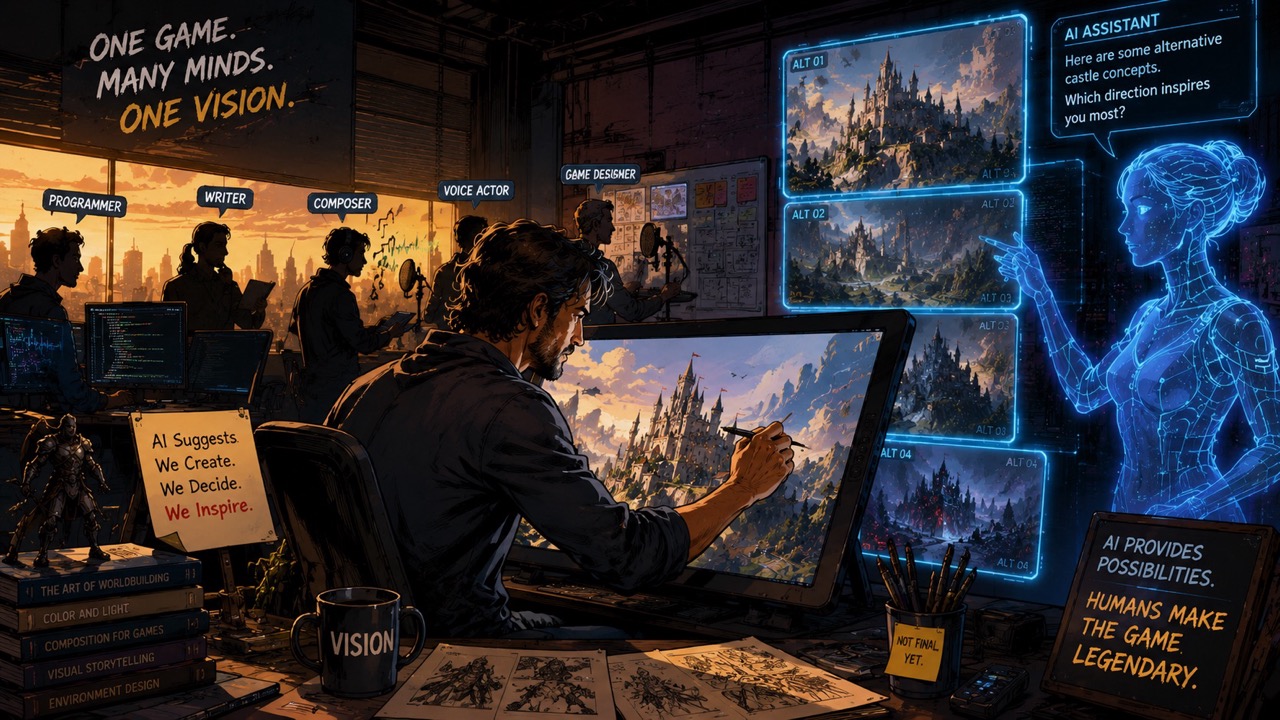
“Every generation inherits better tools. What defines that generation is not the sophistication of those tools, but the wisdom with which they are used.”
If the first two chapters established that artificial intelligence is becoming an increasingly important part of modern game development, they also lead us toward a more difficult conversation. Technical capability is only one side of technological progress. The other concerns judgment—how an industry decides where a tool belongs, where it does not, and what should remain fundamentally human regardless of how advanced the technology becomes. These questions are more difficult because they cannot be answered through engineering alone. They require developers, publishers, artists, and players to think carefully about the kind of creative industry they want game development to become over the next decade.
History suggests that this is not an entirely new dilemma. Every major technological shift has forced creative professions to reconsider the relationship between craftsmanship and efficiency. Digital photography did not eliminate photographers, nor did motion capture replace animators. Modern game engines made development faster, but they did not diminish the importance of programming expertise or thoughtful game design. In each case, the technology altered workflows rather than the underlying purpose of the craft. The most successful professionals were rarely those who resisted change entirely or embraced it uncritically. Instead, they learned how to integrate new tools without allowing those tools to dictate the creative process. Artificial intelligence now presents the gaming industry with a remarkably similar challenge, although its influence extends across far more disciplines than any previous technological innovation.
The Difference Between Producing Content and Creating Meaning
Much of the public conversation surrounding AI assumes that producing more content naturally leads to better games. It is an understandable assumption because modern AI systems can generate images, suggest dialogue, assist with programming, and accelerate numerous production tasks. Yet anyone who has participated in creative work knows that quantity and quality have never been synonymous. The most difficult part of game development has never been generating possibilities; it has always been deciding which possibilities deserve to become part of the final experience.
The castle we imagined earlier provides a useful example. From a technical perspective, software can eventually generate countless architectural variations, complete with towers, walls, courtyards, and intricate decorative details. None of those elements, however, explain why the castle exists within the world or why players should care about it. Was it abandoned after a civil war? Does it protect an ancient secret? Is it a symbol of a kingdom’s decline or the setting for a pivotal moment in the story? These questions transform a collection of digital assets into a place that carries emotional weight. They cannot be answered through geometry, texture resolution, or procedural rules alone because they belong to narrative intent rather than technical execution.
This distinction helps explain why experienced developers often speak about design in terms of purpose rather than production. A memorable game is not simply a collection of impressive assets assembled efficiently. It is a carefully orchestrated experience in which mechanics, environments, characters, music, and storytelling support one another toward a shared creative vision. AI may contribute to many stages of that process, but it does not determine the vision itself. It can accelerate production, yet it cannot decide why a particular story deserves to be told or why one emotional moment should matter more than another. Those decisions continue to emerge from human judgment, and they remain the foundation upon which every memorable game is built.
Why the Debate Among Artists Is More Nuanced Than It Appears
Public discussions often portray the relationship between artists and AI as a straightforward conflict between those who support the technology and those who reject it. In reality, the conversation is considerably more nuanced. Many professional artists already rely on intelligent software features that automate repetitive tasks such as object selection, masking, image restoration, or content-aware editing. These capabilities have gradually become ordinary parts of digital production because they reduce manual labor without replacing the creative decisions that define an artist’s work.
The controversy surrounding generative AI stems from different concerns altogether. Questions surrounding training data, copyright, licensing, attribution, and informed consent remain the subject of ongoing legal and ethical debate across multiple jurisdictions. For many artists, the issue is not whether AI should exist, but whether creative work used to develop these systems has been obtained and applied in ways that respect the rights of its original creators. Those concerns deserve careful consideration because trust has always been central to creative industries. When technology evolves more quickly than the legal and ethical frameworks governing its use, uncertainty is inevitable.
Reducing this discussion to a simple choice between embracing or rejecting AI does little to advance the conversation. Most creative professionals are not arguing against innovation itself. They are asking whether innovation can coexist with fairness, transparency, and professional respect. Those are fundamentally different questions, and they deserve answers that are equally thoughtful rather than polarized.
Performance Is More Than Data
The same complexity appears in discussions surrounding voice acting and performance capture. Advances in voice synthesis have demonstrated that software can reproduce certain vocal characteristics with remarkable accuracy under specific conditions. For developers, these technologies may eventually provide valuable assistance in areas such as temporary dialogue, accessibility, or localization workflows. For performers, however, they introduce questions that extend well beyond technical capability.
A memorable performance is not simply the result of producing spoken words. It reflects interpretation, emotional timing, lived experience, and countless subtle decisions that audiences rarely notice consciously but instinctively recognize. Players remember hesitation before a difficult confession, the quiet determination in a hero’s final speech, or the restrained emotion that makes a tragic scene believable. Those moments arise because actors make creative choices about how a character should feel rather than merely how a line should sound.
This is why discussions about AI-generated voices increasingly focus on consent and ownership instead of technology alone. If a performer’s voice becomes part of a digital system capable of generating new dialogue indefinitely, questions about permission, compensation, and creative control become unavoidable. The technology itself is neither ethical nor unethical. Its impact depends entirely on the standards the industry establishes around its use, reinforcing a broader theme that has emerged throughout this editorial: tools acquire meaning only through the choices people make with them.
A Different Opportunity for the Philippines
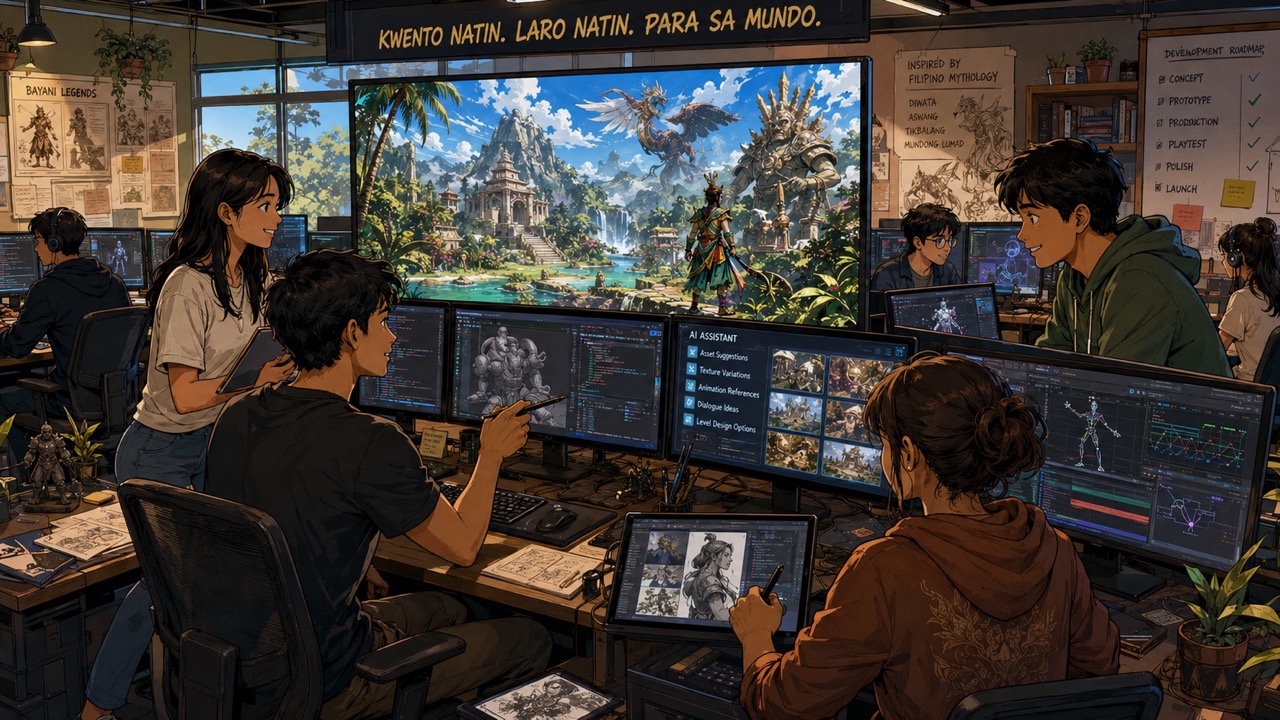
For the Philippine game development community, the rise of AI presents a conversation that differs slightly from those taking place in larger development hubs. Local studios have historically operated under constraints that are less about creativity than about resources. Many Filipino developers possess internationally recognized skills in programming, art, animation, and quality assurance, yet independent studios often work with limited funding, smaller teams, and tighter production schedules than their counterparts abroad.
Viewed from that perspective, AI becomes less a replacement for creative professionals and more a potential force multiplier. Intelligent tools may help smaller teams organize production, accelerate prototyping, improve documentation, expand testing capacity, or shorten repetitive workflows that previously consumed valuable development time. None of these advantages eliminates the structural challenges facing independent studios, nor do they guarantee commercial success. What they may do, however, is allow talented developers to spend a greater proportion of their limited resources on the aspects of game development that players ultimately value most: thoughtful design, polished gameplay, and original ideas.
That possibility carries particular significance for the Philippines because the country’s greatest competitive advantage has never been scale. It has always been talent. If AI enables smaller teams to compete more effectively without compromising their creative identity, it could become one of several tools that help Filipino studios bring more original stories to international audiences. Achieving that outcome will depend not on technology alone, but on sustained investment in education, creative leadership, and a willingness to build intellectual property that reflects local perspectives rather than merely following global trends.
Preparing the Next Generation of Developers
Perhaps no group watches these developments more closely than students preparing to enter the gaming industry. Questions about whether AI will replace programmers, artists, or designers have become increasingly common in classrooms and online communities. Although understandable, these questions often begin from a mistaken assumption—that technical proficiency alone has ever been sufficient for a successful career in game development.
The industry’s history suggests otherwise. Strong programmers have always been distinguished not simply by their ability to write code, but by their capacity to solve complex problems. Exceptional artists are valued not because they can produce images quickly, but because they understand composition, color, anatomy, visual storytelling, and artistic intent. Designers succeed because they understand players, balancing systems, pacing, and human psychology. These foundational skills remain just as important in an era of AI as they were before it.
In fact, the widespread adoption of intelligent tools may increase the value of expertise rather than diminish it. When software can rapidly generate multiple solutions, someone must still evaluate which solution is appropriate, identify subtle flaws, refine rough ideas, and recognize opportunities that no algorithm has considered. Students entering the profession should certainly learn how AI fits into modern workflows, but they should never confuse mastery of a tool with mastery of the craft itself. Tools evolve continuously. Foundational knowledge endures.
The Question Technology Cannot Answer
Throughout this chapter, we have examined the perspectives of artists, actors, programmers, students, and independent studios. Their concerns differ in important ways, yet they ultimately return to the same underlying issue. The central challenge facing the industry is no longer whether artificial intelligence will become more capable; that trajectory is already evident. The more important question is whether the people adopting these technologies can remain deliberate in how they use them, ensuring that efficiency never becomes a substitute for creativity or thoughtful design.
Technology has never possessed values of its own. Every tool reflects the priorities of the people who build it and the people who decide how it will be applied. Artificial intelligence is no exception. It can be used to reduce repetitive work and create more time for experimentation, collaboration, and artistic refinement, or it can be treated primarily as a means of producing greater quantities of content in less time. Those approaches are not equivalent, and the choices developers make today will influence not only production practices but also the creative culture of the industry for years to come.
For that reason, the discussion surrounding AI cannot be reduced to software capabilities or computational performance alone. It is ultimately a conversation about stewardship—about how an industry chooses to balance innovation with responsibility, productivity with craftsmanship, and technological progress with creative integrity. Artificial intelligence will undoubtedly continue to reshape game development, but it will never determine the purpose of that work. As every chapter of this editorial has argued, the purpose has always come from people: from the developers who imagine new worlds, the artists who give them identity, and the players who ultimately decide whether those worlds are worth remembering.
Chapter IV — Beyond the Algorithm
“Technology changes every generation of games. The reasons we remember them have remained remarkably constant.”
Every era of game development has been defined by a technological breakthrough that promised to transform the medium. Three-dimensional graphics expanded the scale of virtual worlds. Broadband internet made persistent online communities possible. Motion capture brought subtle human performances into interactive storytelling, while increasingly powerful game engines enabled smaller studios to build experiences that once required enormous technical resources. Each advancement reshaped development in meaningful ways, yet none of them fundamentally changed why people became emotionally attached to games.
Players rarely remember a title because it introduced a more efficient production pipeline or adopted the latest rendering technique before its competitors. They remember the first time they stepped into an unfamiliar world and felt compelled to keep exploring. They remember solving a puzzle that seemed impossible only moments before, defeating a boss after dozens of failed attempts, or reaching an ending that lingered in their thoughts long after the credits finished rolling. Those experiences endure because they are emotional rather than technical. Technology makes them possible, but it is not the reason they matter.
Artificial intelligence now joins this long history of transformative tools. Like every innovation before it, it expands what developers are capable of building while simultaneously challenging the industry to reconsider how those capabilities should be used. The significance of AI, therefore, is not that it introduces change—change has always been part of game development—but that it encourages the industry to distinguish more clearly than ever between what can be automated and what should remain an expression of human creativity.
Progress Has Never Been Measured by Automation Alone
One of the recurring assumptions surrounding AI is that technological progress naturally follows a single direction: toward greater automation, faster production, and fewer manual processes. From a manufacturing perspective, that reasoning appears sensible. In creative industries, however, progress has rarely been measured solely by efficiency.
If efficiency alone determined artistic success, the largest development teams would consistently produce the most memorable games. History suggests otherwise. Some of the industry’s most influential titles emerged not because they possessed the biggest budgets or the most advanced technology of their time, but because they introduced fresh ideas, distinctive artistic identities, or new ways of engaging players. Innovation in game development has always depended as much on creative risk as on technical achievement.
Artificial intelligence does not change that relationship. It may reduce the time required to complete certain production tasks, allowing studios to iterate more quickly or allocate resources more effectively. Yet no algorithm can determine whether a mechanic is genuinely enjoyable, whether a story resonates emotionally, or whether a world invites curiosity rather than obligation. Those judgments require taste, empathy, cultural awareness, and an understanding of human experience that extends beyond pattern recognition.
For that reason, discussions about AI should not focus exclusively on what developers can automate next. They should also consider what automation makes possible. If repetitive tasks consume less time, creative teams gain additional opportunities to refine gameplay, strengthen narrative cohesion, improve accessibility, or simply polish details that might otherwise remain unfinished. In that sense, the true value of AI may not be measured by how much work it performs, but by the creative freedom it gives back to the people directing the project.
The Games We Will Remember
Earlier in this editorial, we returned several times to the image of a castle standing on the horizon. It served first as a symbol of production complexity and later as an illustration of how meaning emerges through design rather than technical execution. Before leaving it behind, it is worth considering one final question.
Imagine that castle appearing in two different games.
In the first, every stone, banner, corridor, and tower has been assembled through an exceptionally efficient production pipeline supported by advanced AI systems. Technically, it is flawless. Lighting is realistic, textures are detailed, and performance remains stable across every supported platform.
In the second, the castle may have benefited from many of the same technologies, yet what players remember is something else entirely. They remember climbing its highest tower after spending fifty hours unraveling the history of the kingdom. They remember the conversation that took place within its walls, the difficult choice they were forced to make, and the consequences that followed. Years later, they may have forgotten how impressive the rendering technology looked, but they still remember how that moment made them feel.
The difference between those two experiences cannot be explained by technology alone.
It lies in authorship.
One demonstrates technical competence.
The other demonstrates creative intention.
As artificial intelligence becomes increasingly integrated into development pipelines, preserving that distinction may become one of the industry’s most important responsibilities.
A Responsibility Shared by the Entire Industry
It is tempting to assume that decisions about AI belong exclusively to technology companies or large game studios. In reality, the future of AI in gaming will be shaped by a far broader community.
Developers determine how new tools fit within creative workflows. Publishers establish production priorities and allocate resources. Engine developers design the platforms upon which future games will be built. Universities and training institutions prepare the next generation of programmers, artists, designers, and technical specialists. Legislators and courts continue defining the legal frameworks surrounding copyright, licensing, and digital ownership. Finally, players influence the direction of the industry every time they decide which games deserve their attention and support.
This shared responsibility is one reason simplistic narratives about AI rarely withstand closer examination. The future will not be determined by a single technological breakthrough or by one company’s strategic decisions. It will emerge through thousands of individual choices made across an interconnected industry, many of them invisible to players but collectively influential in shaping how games are conceived, developed, and experienced.
For that reason, thoughtful discussion remains more valuable than certainty. The questions surrounding AI are too complex to be resolved through optimism alone or skepticism alone. They require ongoing dialogue between people who care about technology and people who care about creativity, because the future of game development ultimately depends on both.
After the Credits
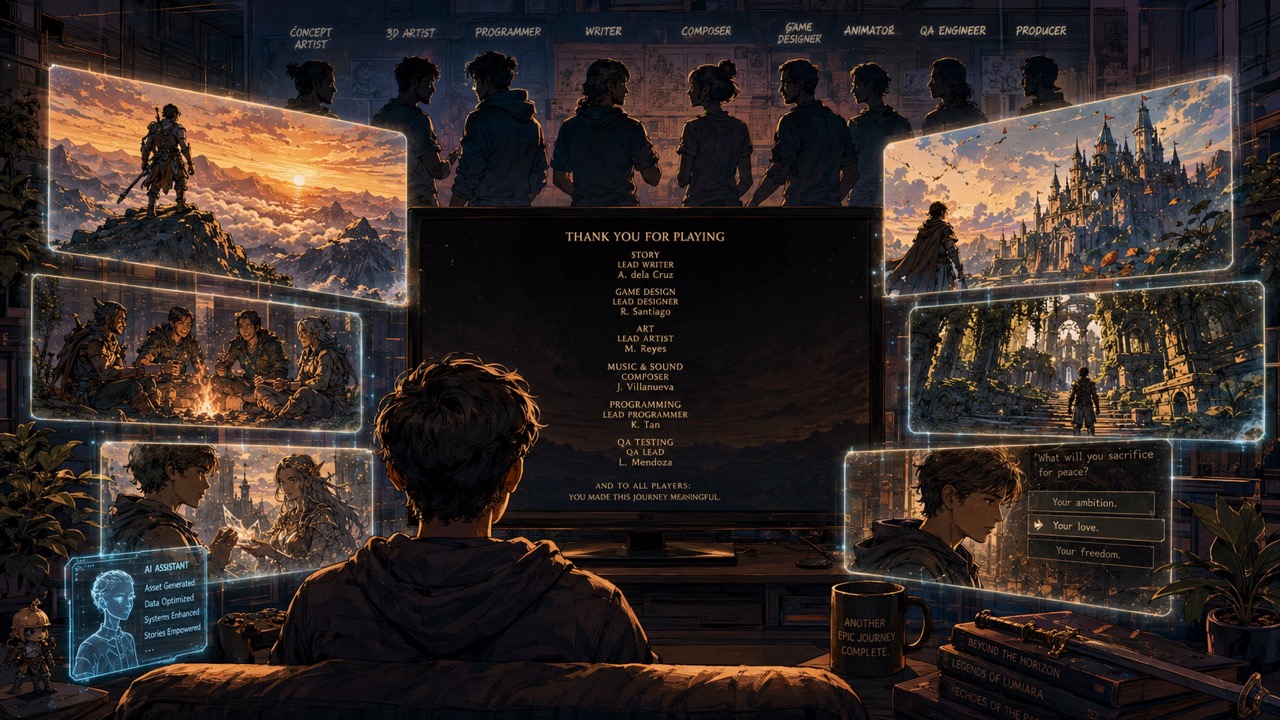
Every memorable game reaches a moment when the action ends, the music softens, and the credits begin to roll. It is often during those final minutes—not during the climactic battle—that players quietly reflect on everything they have experienced. The mechanics fade into the background, leaving only the emotions, ideas, and memories that made the journey worthwhile.
Artificial intelligence may eventually become so deeply integrated into game development that players stop noticing it altogether. If that happens, it will not diminish the importance of the technology. On the contrary, it will suggest that AI has achieved what many foundational technologies achieve at their best: becoming an invisible part of the creative process rather than the center of attention.
Yet even if that future arrives, one truth is unlikely to change.
Games are remembered because they reveal something about the people who create them and the people who play them. They reflect curiosity, imagination, ambition, humor, empathy, and the uniquely human desire to tell stories through interactive worlds. No production pipeline, regardless of how sophisticated, can generate those qualities on its own. Technology may expand the range of what developers can accomplish, but it does not determine why they create in the first place.
Perhaps that is the most useful way to understand AI’s role in gaming.
It is not the author of the industry’s next chapter.
It is another instrument through which talented people may choose to write it.
As developers continue exploring the possibilities of artificial intelligence, the conversation should never lose sight of what has sustained gaming through every previous technological revolution. New tools will continue to emerge. Hardware will become more powerful. Production techniques will evolve, and today’s innovations will eventually become tomorrow’s standard practice. Through all of those changes, however, the measure of a great game will remain remarkably familiar. Players will still ask whether the world felt believable, whether the characters mattered, whether the mechanics respected their time, and whether the experience left them feeling something that could not be replicated elsewhere.
Artificial intelligence will undoubtedly influence the answers to those questions. It may help developers build larger worlds, solve technical problems more efficiently, and explore ideas that once seemed impractical. But the answers themselves will continue to come from people—from the imagination that conceives a world, the craftsmanship that gives it form, and the courage to create something worth remembering.
In the end, that may be the quiet lesson hidden beneath all the excitement surrounding AI.
The future of game development has never depended on technology alone.
It has always depended on what people choose to create with it.